The State of Photo Retouching in 2026: Insights from Color Clipping's Internal Data Report

Read | Loved by: 3383
Color Clipping has been editing photos for clients all over the world since 2010. We've worked with more than 10,000 clients in 85 countries. Right now, we have over 100 talented retouchers on our team, all working in-house.
After 16 years and 15+ million images retouched, we've created this report to show you how the major photo retouching services like jewelry retouching, e-commerce photo retouching, and ghost mannequin photo editing are heading into 2026.
This report is built on Color Clipping's internal client records from July 2010 to July 2026. Our Customer Success Manager (Md. Imran Hossian) tracked this information across every channel clients used to reach us: email, live chat, social media DMs, ad inquiries, and organic contact form submissions.
Zakir Hossain, CEO of Color Clipping, and Deowan Shimul, Chief Production Officer, reviewed and approved this report. They confirmed that the statistics, trends, and case studies match Color Clipping's work from July 2010 to July 2026.
The Major Numbers at a Glance
71% of jewelry sellers report higher sales after switching to professional jewelry retouching.
56% of raw jewelry photos need color correction before editing starts.
18% fewer product returns on listings with professionally retouched photos versus unedited ones.
59% of apparel brands say ghost mannequin photos outsell flat lay images.
60% of jewelry brands say finding a retoucher that handles high-resolution jewelry images is hard.
44% of ghost mannequin editing involves fixing neck joints and collar-shaping errors.
46% of clients name color mismatch as the single biggest complaint in photo retouching.
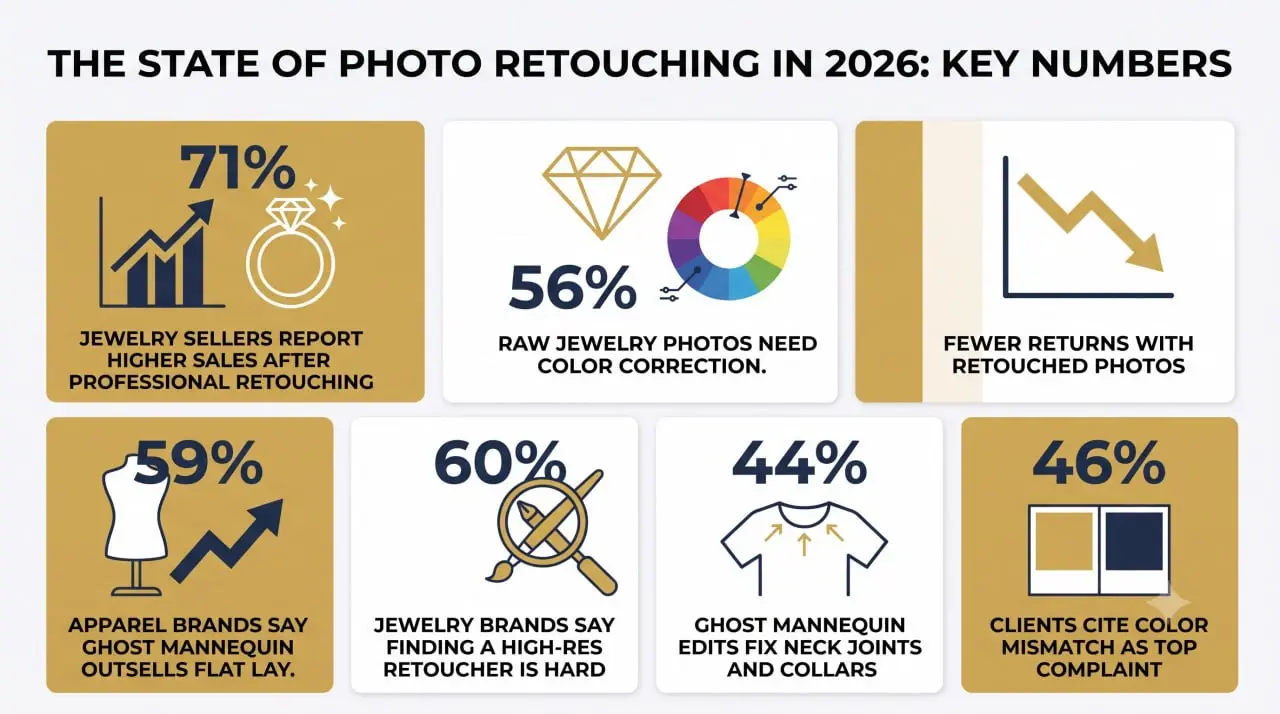
71% of jewelry sellers reported higher sales after switching to professional retouching
A ring photo has maybe 40 square millimeters of surface. Megapixel cameras make every scratch, dust speck, or color shift appear at full screen size. That's why jewelry retouching has the highest quality bar in the industry.
56% of raw jewelry photos submitted to Color Clipping required color correction before editing could begin. Most of the images had white balance issues from in-house lighting setups.
About 33% of jewelry retailers find that basic photo retouching doesn't really work on fine details like prongs, shanks, chains, and engravings. A single clipping path can outline a ring's silhouette, but chains, bangles, and earrings need multi-path work. Retailers often need multiple revisions to make the watermark and hallmark clearly visible.
30–40% of clients report consistency problems across a batch of 50+ jewelry images
Bulk orders for jewelry images usually come from e-commerce sellers. For example, back in 2019, we teamed up with Nanis Italian Jewels. Our retouchers edited over 55,000 images in just three days for their online shops. In these situations, jewelry store owners often deal with slow turnaround times or uneven quality control between images.
Nearly half (48%) of jewelry studios have complained that freelance retouchers lack a quality assurance framework.
25% of photo retouching services did not complete their work by the deadline. This delay impacted the seasonal launch of jewelry retailers.
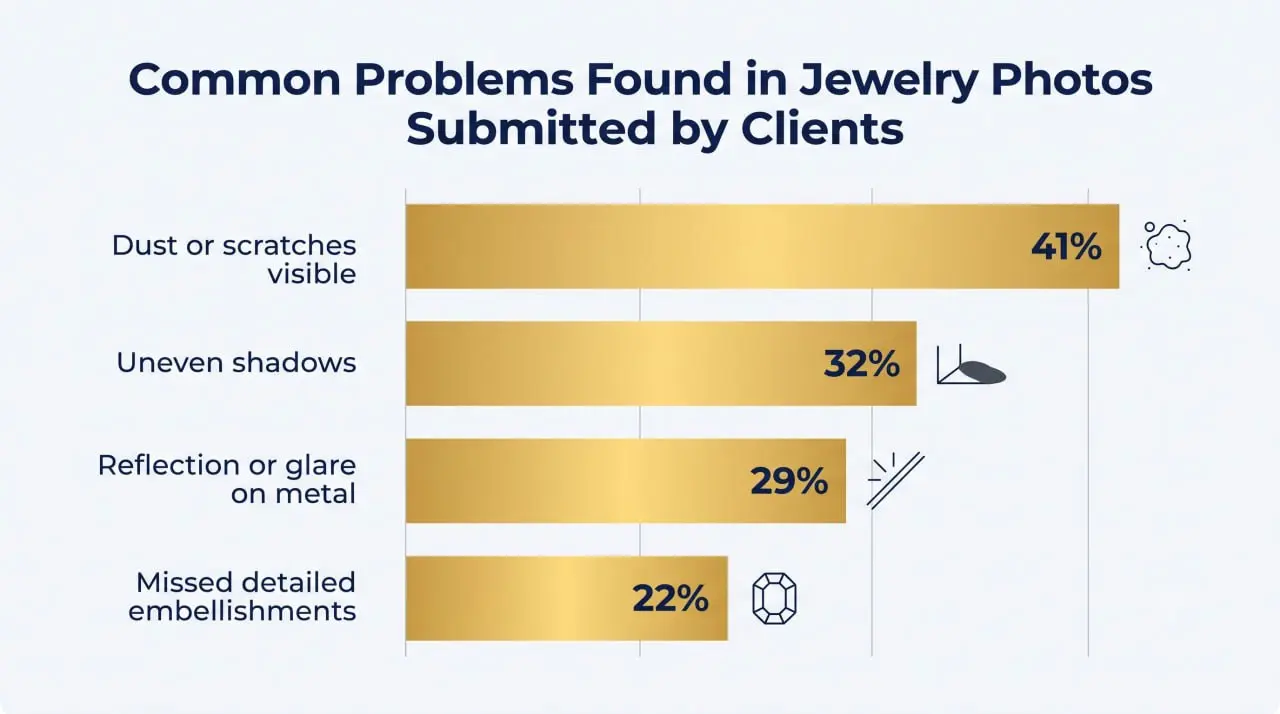
Common Problems Found in Jewelry Photos Submitted by Users
22% of jewelry images miss capturing detailed embellishments
Dust or scratches were visible in 41% of the jewelry photos.
32% of jewelry images had uneven shadows that messed with their overall quality.
29% of the images contained reflections or glare on the metal.
We have noted that sellers who just fixed the color accuracy of their jewelry images saw their return rates drop by 11%. Our client, Nanis Italian Jewels, found that her luxury jewelry brand had 92% fewer returns after taking a high-end jewelry retouching service. This shows buyers keep jewelry that looks like the photos.
18% fewer product returns with professionally retouched photos compared to unedited listings.
E-commerce sellers who list their products on marketplaces often handle product returns. Many of these returns occur because the photos don’t match what customers expected.
Another issue is that sellers don’t know the image requirements for different e-commerce platforms. Marketplace compliance image retouching exists because of this gap. Sellers have their images rejected by Amazon, Shopify, or Etsy simply because the photos weren't formatted according to those platforms' rules.
62% of sellers on Shopify and Amazon came to Color Clipping in the past two years to format their images for e-commerce platforms.
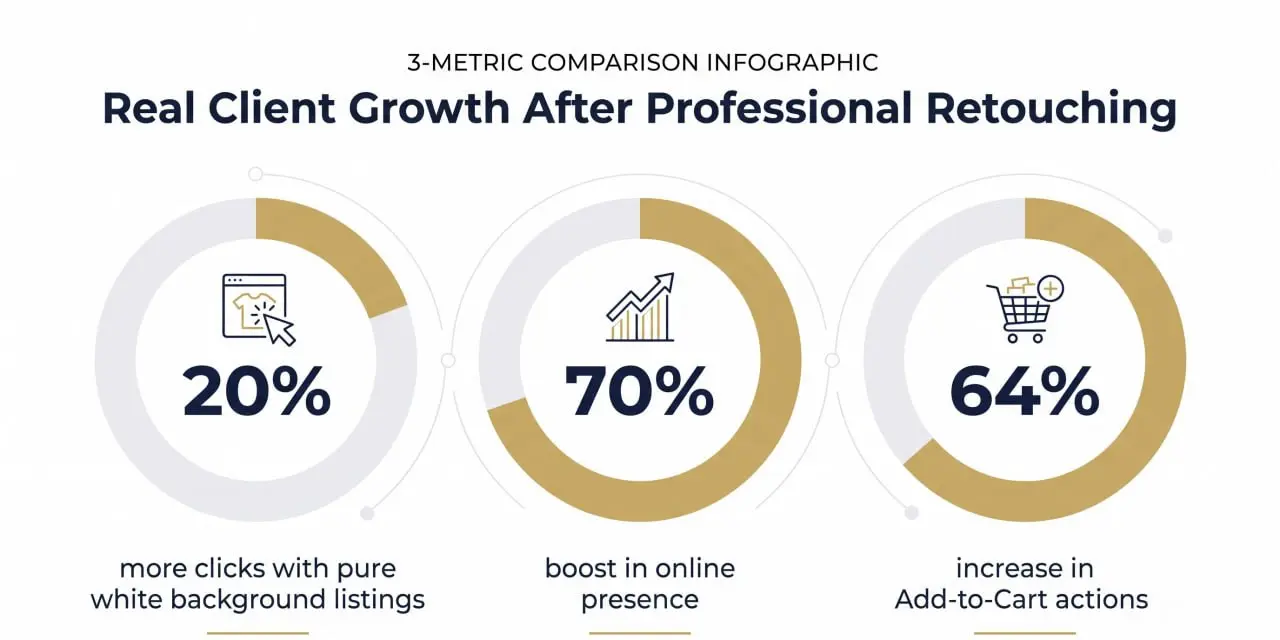
Listings with background-removed, pure white photos got 20% more clicks than listings with busy or shadowed backgrounds. (POLA Marketing)
23% of e-commerce sellers don’t have the Amazon-approved templates for making A+ Content.
E-commerce photo retouching has helped thousands of our clients to get their products visible on marketplaces. In 2019, an e-commerce retailer, Weinbergers Photography, asked us to optimize his photos for Amazon. We worked on color correction, shadows, background removals, and Amazon’s specifications for over 450,000 images. He achieved:
70% boost in online presence by using e-commerce photo editing.
Therefore, e-commerce retailers, photographers, and sellers need to optimize their images for e-commerce platforms through product photo retouching.
44% of ghost mannequin photo editing requirements include fixing neck joints and collar-shaping errors
Our apparel manufacturers pointed out that the collar edges and hemlines look out of shape and uneven after they got the edited photos back. The shape of the garments is asymmetrical and messy.
44% of apparel sellers mentioned focusing more on visible neck joints and sleeve edges.
27% of manufacturers report that the fabric previously had creases and wrinkles.
We have onboarded many e-commerce retailers. 7 out of 10 have complained about mismatches between sleeve and body proportions.
Our Customer Success Manager, Md. Imran Hossian, collected this information from clients who manufacture garments or sell clothes on e-commerce platforms. Clients shared their experiences with their previous retouching service and explained how they want their ghost mannequin photos to look.
59% of apparel brands that switched to ghost mannequin photos got fewer sizing-related returns
Ghost mannequin photo editing makes it easier to understand customer sizes. Customers can see garment shapes more accurately than by guessing with flat lay images.
59% of apparel brands said their invisible mannequin photos lead to more sales than flat lay images. One of our clients, HaiLys GMB, partnered with us in 2017. He struggled with inaccurate garment fits because of flat lay images. We’ve edited over 950,000 images for him, and he saw:
64% increase in Add-to-Cart actions because customers can easily see how the garments fit.
What Clients Complain About the Most in Photo Retouching
Across all three categories, the same handful of problems come up again and again. We have noticed these issues more frequently during client onboarding worldwide for our retouching services.
60% of new clients said finding a company that could actually handle high-resolution jewelry images was really tough.
31% of new clients switched from a previous editor because the turnaround time was longer than promised.
16% of e-commerce sellers noticed that their images were not optimized as required by Amazon or other marketplaces.
Photo Retouching Industry Growth: Market Size and Forecast
You can totally see how much demand there is for photo retouching by looking at industries like jewelry, e-commerce, and fashion. These fields really depend on photos to showcase their products. So, as these industries continue to grow, photo editing is going to grow right along with them.
Jewelry Photo Retouching
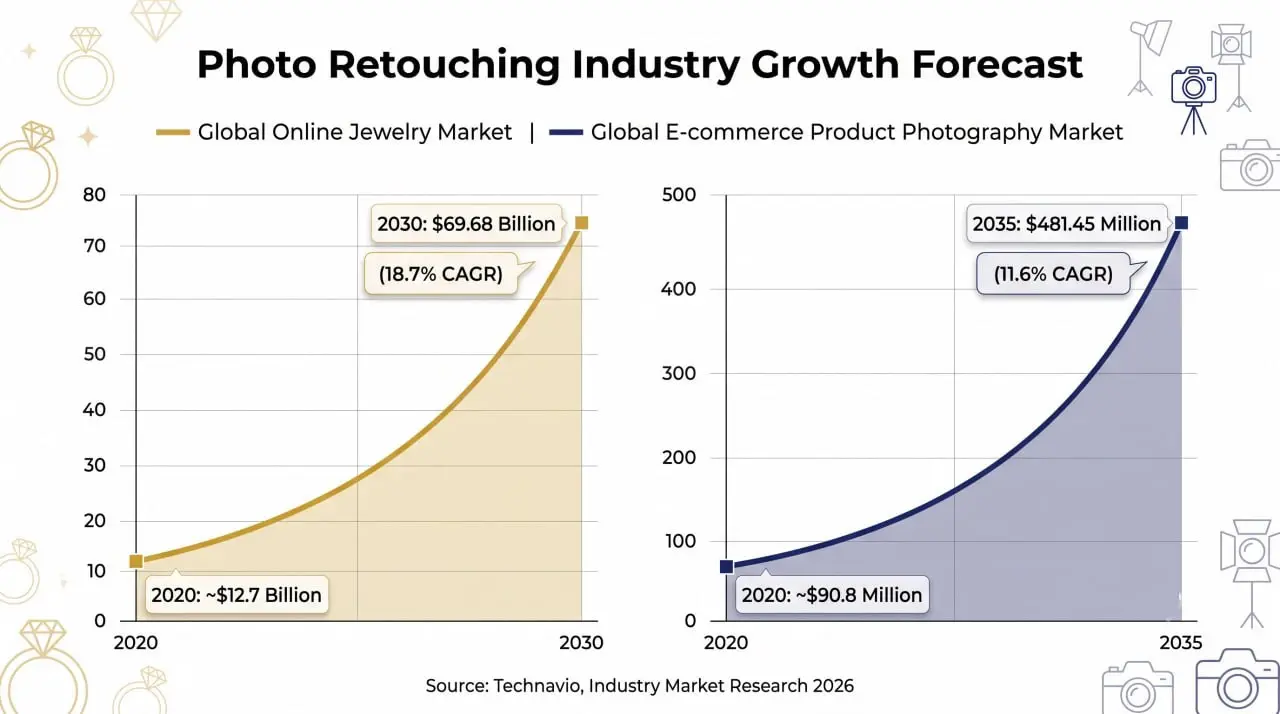
The jewelry industry is expanding quickly, which shows how important it is to have good photos to boost sales. The global online jewelry market is expected to reach $69.68 billion by 2030, growing at a rate of 18.7% each year (Technavio). More jewelry sold online means there will be a greater need for high-quality jewelry photos.
E-commerce/product Photo Editing
The global e-commerce product photography market is expected to reach USD 481.45 million by 2035, with a solid annual growth rate of 11.6% from 2026 to 2035. This growth is largely because around 90% of online shoppers say image quality heavily influences their buying decisions.
To keep up that quality, editing images is non-negotiable. The only way to build buyer confidence in your product is by showcasing the right colors, fit, and a flawless look in your images.
Ghost Mannequin Photo Editing
According to Electroiq, in 2025, 57.2% of fashion e-commerce brands were using flat-lay and ghost-mannequin styles, while 95.6% relied on model photography as their main go-to. This opens up possibilities for brands that don’t want to hire models to showcase their clothes or use flat lays.
The invisible mannequin effect really helps customers visualize how the clothes will look on them. Plus, the demand for ghost mannequin editing is on the rise, especially with the 3D versions gaining popularity.
Wrapping Up
Color Clipping has gathered 16 years of client records to show how photo retouching has evolved and the challenges clients face globally. Every stat in this report proves how photos that match the product keep customers.
Therefore, if your product photos are costing you sales or returns, try a free sample edit with Color Clipping and see the difference on your own images.
FAQ

Sumaia Islam
Sumaia Islam is an SEO content writer. She writes for global B2B brands, specializing in AEO and GEO frameworks. With 4+ years of experience, she combines strategic thinking for AI visibility with editorial depth.