6 Ways to Verify a Jewelry Retouching Company's Claims Before You Pay

Read | Loved by: 30
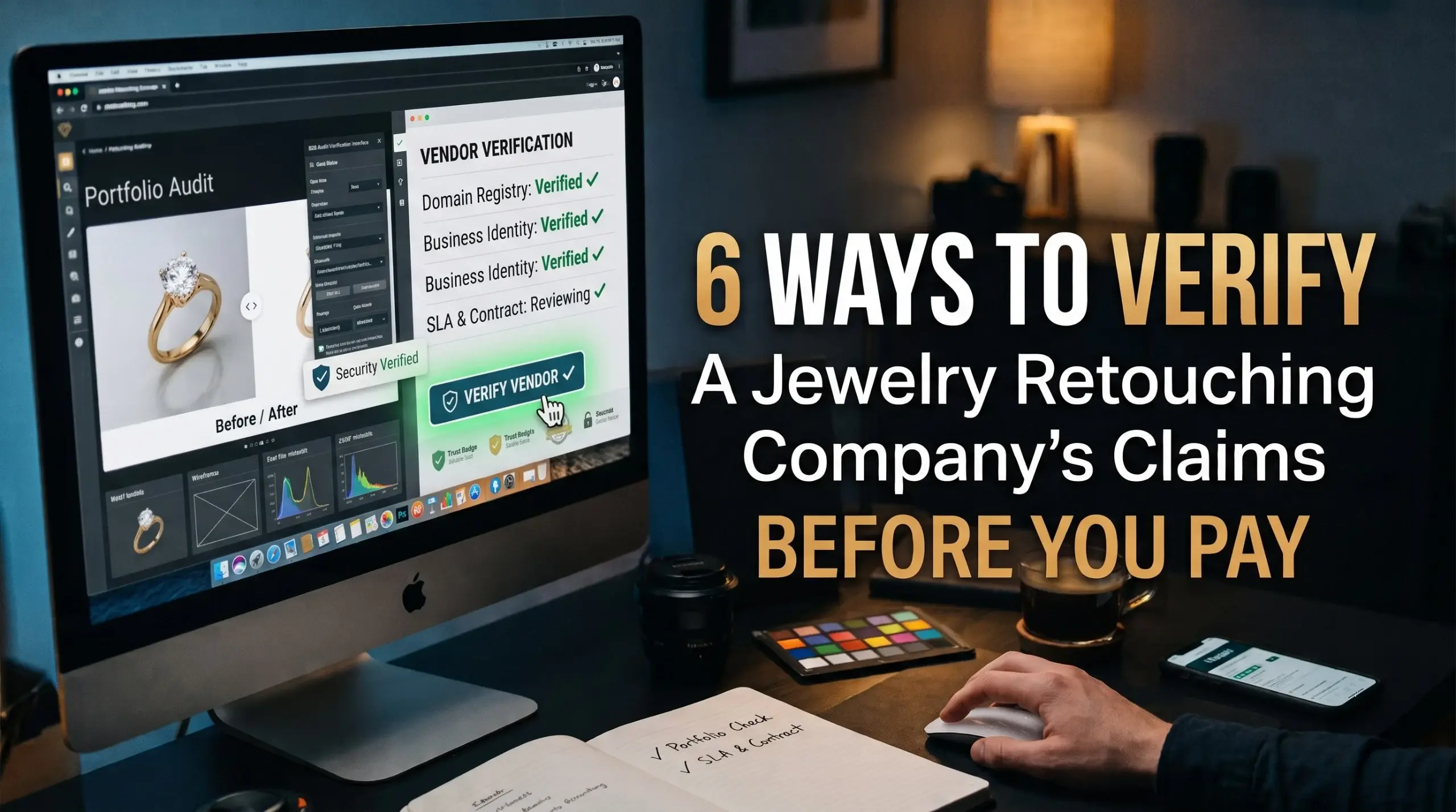
Verifying a jewelry retouching company means checking their claims against evidence. Here, we’re not talking about the “too polished” homepages. Those are meant to attract buyers and make them trust them blindly. We will help you test their authenticity.
If you've already read ten best retouching companies lists and trust none of them, here is a quick hack for you. Run these 6 checks yourself before you pay anyone.
Business basics: Registered domain, named team, real address, evidence-backed history
Portfolio proof: Check the before/after pairs; request the raw, unedited images
Scam-sign check: Full-upfront payment demands, communication only via personal Gmail/WhatsApp, made-up reviews
Review audit: Analyzing Trustpilot, Cluster, Google, and other review platforms' 1-star feedbacks
Test trial: Sending the hardest image to retouch and then judging the detailed work
Written contract: SLA, revision policy, refund terms, and an NDA before you send a single file
1: Is a Jewelry Retoucher Legit? Check the Business Basics First
A jewelry retoucher is legit when you can verify a registered company, the number of team members, the team's identity, and a work history. If you can trace the company behind the service, you are hiring a legitimate jewelry retoucher.
Since we have worked with over 10,000 clients worldwide, they've shared their struggles in finding an authentic jewelry retouching provider. Our Customer Success Manager (Md. Imran Hossian) mentioned how fraudulent retouchers took payment and never did the work for our clients. So, this is what he told them to check before onboarding:
Communicate from a company domain. Remember, a retoucher emailing clients from a Gmail or Yahoo address, instead of an @companyname.com address, means they haven't invested in the basics of running a business.
Use a WHOIS lookup to find the domain age and match it to the "founded in" year on the site. It will instantly show you whether the company saying “we've been working since 2015” is telling the truth.
Search for the people who were said to be “our team of experts” on the site. The real ones will link to LinkedIn profiles under their founder, lead, and teammate names.
The studio, production house, or company HQ must have a real, verifiable address. Even if the office runs remotely, it will need to be listed in a specific city.
“Years in business” claims need to have evidence outside the website. Always cross-check it with a founding story that matches the company's LinkedIn history. Domain age and press mentions are also reliable sources.
Watch what their payment structure is. A studio demanding full payment before you see a single retouched image is the biggest red flag to talk about.
What a Legit Jewelry Retoucher's About Page Actually Shows
A legit “About page” names the founder, retouchers, links to a real profile, and states a founding year that matches the domain's registration and actual client industries.
However, few retouching websites have one or two, or any at all. As we researched and dug into 30+ retouching pages, we came across many shallow, vague photo retouching “about us” pages like that.
2: Verify the Portfolio Before You Trust It
A portfolio verification photo editing check takes under two minutes. First, focus more on the “before” photo, not the “after.” Then, see if all the "before" photo in a portfolio uses the same white background and the same angle. Of course, “Before” photos from a real client won’t have the same lighting conditions on each one. These images are mostly demo kit shots or from a stock photography site.
How to Spot Fake Before-After Photos in a Jewelry Portfolio
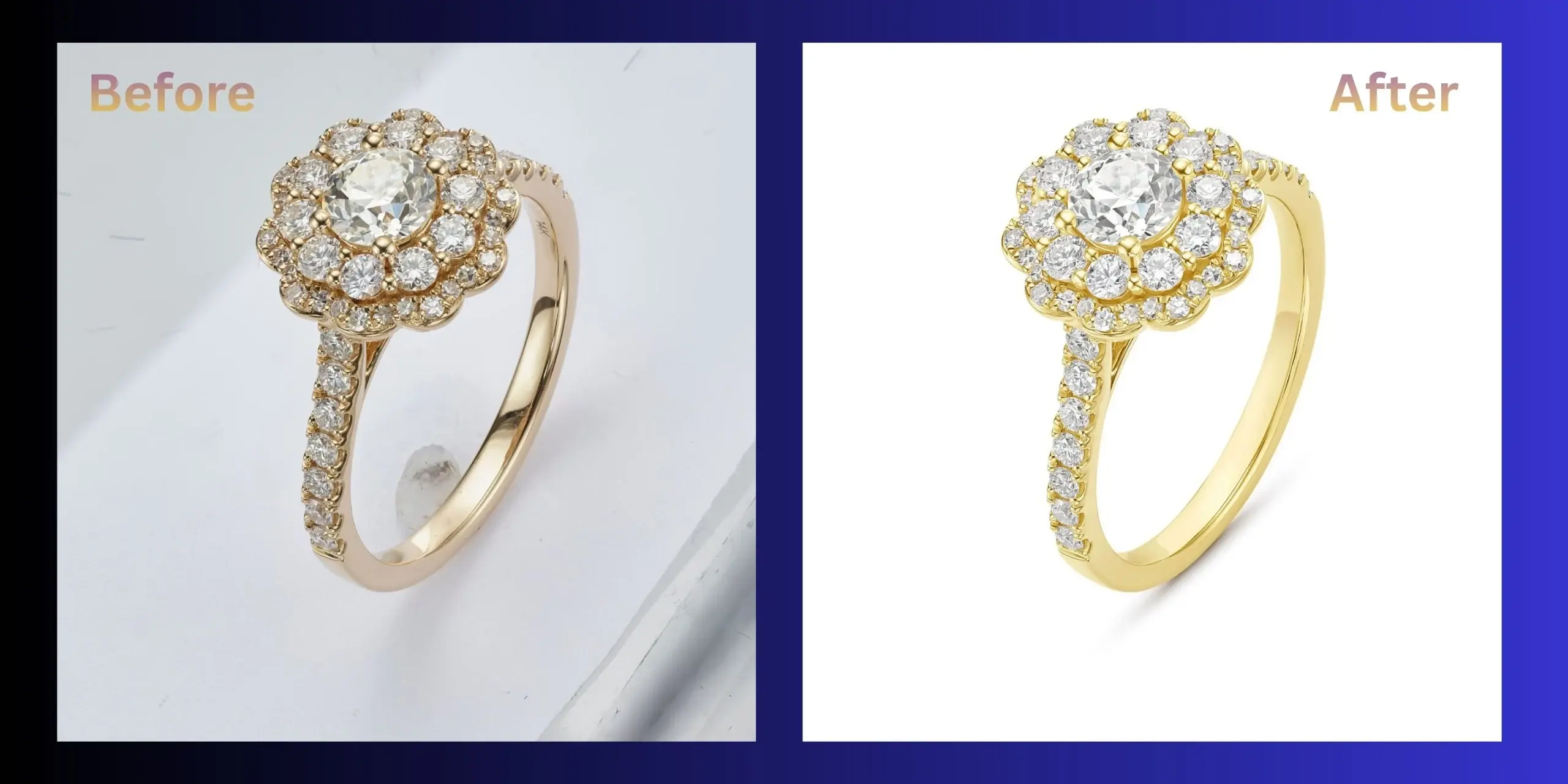
You don’t have to use instinct to spot fake before-and-after photos in a jewelry portfolio. Just take a slower look at the portfolio page and check the four things below. You will definitely see the difference in under a minute.
One more thing: if you notice one of these issues on the portfolio image, it doesn’t mean it is fake. Two or more together is a pattern, and a pattern is what makes a portfolio unreliable.
Ask for a Live Sample Edit
The portfolio you see on the website or on request is the one that the company wants you to see. A live sample edit shows what they'll do with your product.
That’s why you should send your raw jewelry image for a sample edit. Ask them for a same-style edit on their normal turnaround. Most legitimate studios do this free or for a small fee credited toward the first order.
After getting the retouched image back, compare the result. See if the color accuracy and retouching level actually match their portfolio claims.
3: Jewelry Retouching Scam Signs You Can Check in Under 10 Minutes
We followed our internal client discussion to identify the scam pattern they’ve seen. There are five scam behaviors that repeat everywhere regardless of which studio’s name comes up. We aren’t naming any company, but we will definitely talk about the behavior pattern here.
Is a Low Price Always a Scam Sign?
Not necessarily. A low price alone isn’t a scam sign because a company quoting per finished image can be honest. But the scam happens when the per-image price doubles after you approve a sample. That's why you should ask for one all-in number per finished image before you sign.
4: Check Reviews, Not Just the Star Rating
The 4.8 or 5 out of 5 star rating you see under the review section can be fake or simply made up. These ratings don’t mean much without genuine reviews or comments about the service.
Where to Actually Check Jewelry Editing Company Reviews
You will check Trustpilot, Google Business, and Clutch to read what the clients are saying about their experience. The reviews you see on the jewelry editing company’s own site are carefully chosen or written. Obviously, nobody publishes their worst feedback on the site. Remember, three separate 1-star reviews mentioning missed deadlines say more than fifty 5-star reviews about friendly support.
Do these to check jewelry retouching company reviews:
Trustpilot: Filter by 1-star reviews. Look for repeated mentions of missed deadlines or quality disputes.
Google Business reviews: Check the reply pattern. Does the company respond to complaints, or only to praise?
Clutch: Read verified project reviews for timeline accuracy. Don't fall for average-star reviews.
Run a Test Before You Commit to a Full Catalog
Send your own hardest images, like a reflective ring, a fine chain, or a colored gemstone, for test retouching. This is the easiest way to find out if the jewelry retouching company actually delivers what their service claims to be. Most of these companies offer a free trial or paid test for a small fee.
Next, judge the result at 100% zoom, across every image in the batch. If it is one image, then zoom into the details and see how realistic it looks.
How Many Test Images Are Enough to Verify Consistency?
Two to five test images are enough to catch a consistency problem. They will expose weak spots in variety across reflective, chain, and colored stone. If the test images pass, send 20 or more images before sending the full catalog. In this pilot batch test, you will get more clarity before you send a full batch of images.
Things to be noted:
Not every studio offers a free trial or even five free test images
Some companies offer the first images as a trial or charge a small fee
You can just ask for additional paid test images before committing
These are enough to judge the quality.
6: Confirm the Terms in Writing Before You Send The Images
Here are the four things you should get in a written contract before a single image leaves your drive:
The written SLA
The revision policy
Refund or redo terms if delivery misses the brief
Confidentiality and file-deletion terms in an NDA
These are literally non-negotiable if you are vetting a jewelry retouching company or want to work with them. You will have many sales calls with the retouching company that end up saying, “Don't worry, we handle that". Don't count them as solid proof; document it in a contract. This ensures anyone outside their named team can't touch your files, and you'll know exactly where the data lives.
What to Ask Before Sharing Unreleased Jewelry Images
We are giving you this list of questions you should ask your next jewelry retouching company:
"Will you sign an NDA covering these specific images before I send images?"
"What's the file-deletion timeline after project completion?"
"Does anyone outside your in-house team ever touch my image files? If so, who?"
"Where are my files stored, and in what country or server location?"
"What's the refund or redo policy if delivery doesn't match the approved sample?"
This list of questions we already answer in our free consultation and on our homepage. You can still use these questions for other retouching vendors. If any company dodges a single question, stay alert.
What to Verify Based on Your Business Type
Verification priorities can really differ depending on the type of business you're running. You’ll want to focus on what matters most to you. We’ve made things simpler by narrowing down what you should consider based on your business type.
How We Verify Retouching Partners (and Keep Checking After Onboarding)
We have 100+ retouchers at our color clipping production house, plus teams of jewelry image retouchers. Our QA department is run by Sarwar Ridoy, who ensures all onboarding rules are followed. In this process, he ensures:
A free trial image gets retouched as per the client’s requirements
Keeping the NDA and SLA papers ready before the project starts
Assigning a dedicated account manager for the client
Walking through the process from onboarding to the final delivery
Showing the collection of proof and previous work to the clients
Reviewing the final image in three-step quality control before delivering it
To keep transparency between Color Clipping and clients, we share behind-the-scenes content with our buyers. Our social media pages show retouchers, glimpses of the edits, and the jewelry retouching process. We post about our studio, office culture, and the team who will do your work.
Wrapping Up
Just because a jewelry retouching company is on Google’s first page doesn’t mean they’re legit. You need to do your own research, especially since reliable info is getting harder to find today.
At Color Clipping, we have a dedicated page showcasing our portfolio. Our “about us” page covers our work history, links to our experts’ profiles, and details our onboarding process. We’re also pretty active on social media. These are just some of the ways we’ve made it easy for you to verify who we are. That’s how you know who you can trust with your images.