Who Still Hires Human Retouchers? 5 Buyer Types Explained

Read | Loved by: 104
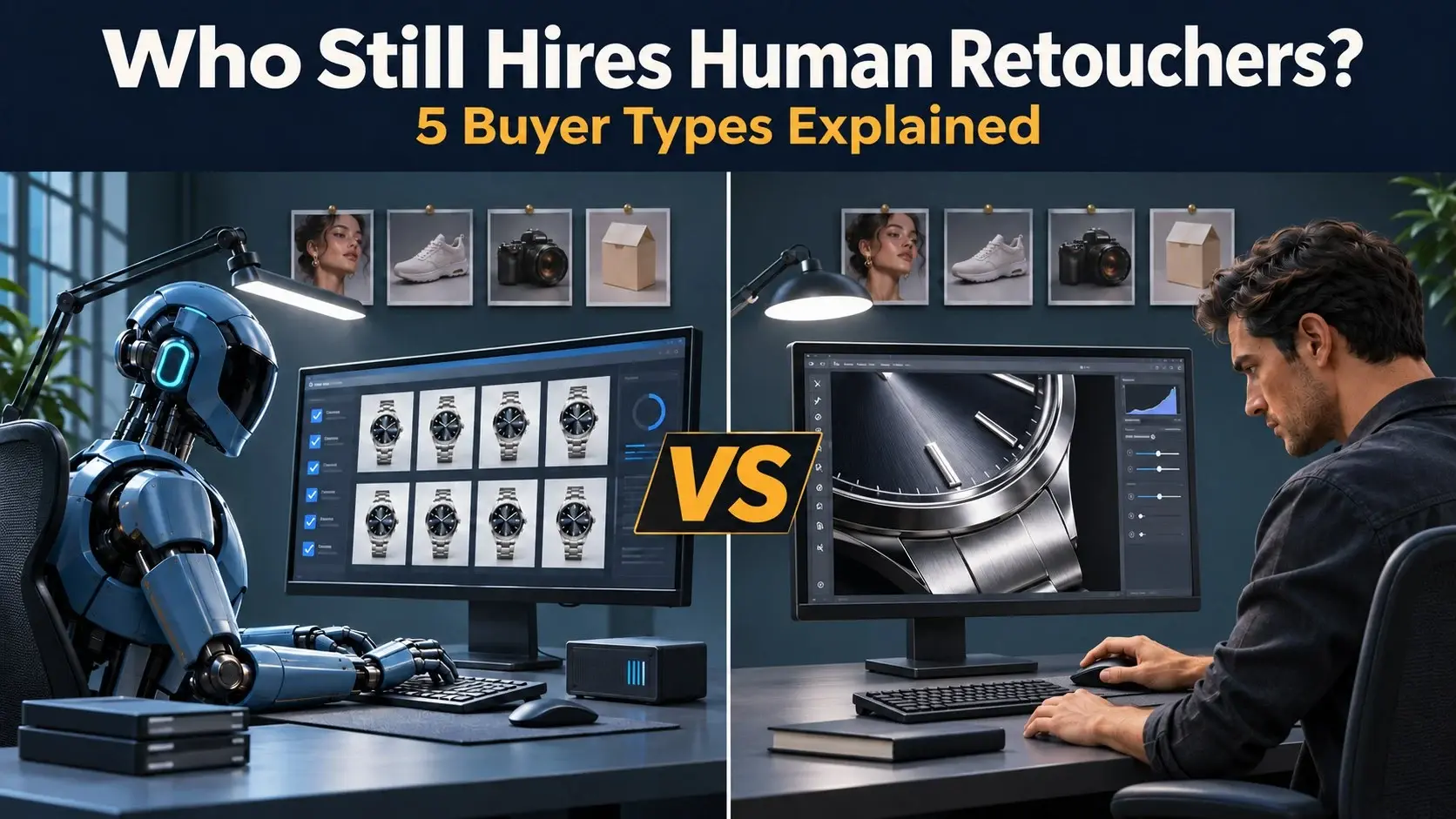
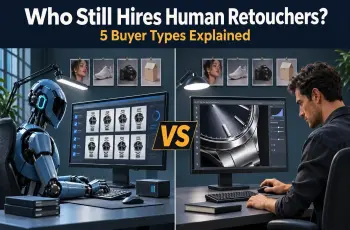
Luxury jewelry and watch brands, fashion and beauty brands, Amazon and marketplace sellers, photographers and studios, and packaging and print brands. They run AI for simple retouching tasks in bulk orders and keep human photo retouching for images where mistakes show. This guide explains all 5 buyer types and how to choose between human, AI, or hybrid.
What does "human retoucher" mean in 2026?
A human retoucher is a skilled editor who finishes and approves the images AI can't handle alone. Basically, human retouchers do the manual retouching AI can’t and ensure AI-generated images are accurate. In 2026, photo retouchers usually work alongside AI retouching tools.
Are human retouchers still hired, or has AI replaced them?
Yes, they are still hired. AI has not replaced them. The market has moved to a hybrid model, often called "AI first, human refine" or human-in-the-loop. AI takes the basic retouching needed for bulk catalog editing. It makes simple retouching methods like clipping paths much easier and time-saving. Skilled editors take the wrong images, hero shots, and interactive product images and work with them.
Which retouching jobs does AI handle well?
AI works best on predictable jobs with simple images:
Background removal
Simple clipping path
Surface-level dust cleanup
Basic Color matching
Batch consistency
Where does AI still fail?
AI still fails on reflective metal, gemstones, hair, glass, and skin texture. The most visible failures are an overpolished look, plastic skin, unwanted elements, and gibberish text. It polishes images in a way that looks fake and unreal, and it's easy to spot. These kinds of images remain unreliable to customers.
Who still hires human retouchers? (Buyer types)
We’ve identified 5 industry/business categories that still heavily rely on human photo retouching. That doesn’t mean they have restricted AI usage; they have smartly incorporated the tools.
1. Luxury jewelry and watch brands
Luxury jewelry and watch brands hire human retouchers most. Their pieces are small, shiny, and costly, and buyers zoom in. AI tools mess up these images by adding too much sparkle and changing the actual color.
Why humans: Metal can pick up the wrong environmental reflection. Prong highlights can vanish, and gemstones lose inner contrast. Our retoucher mentioned, “AI often mistakes a real facet reflection for a dust particle.”
What AI handles: AI tools can clean surface dust from jewelry stones, add shadow, and remove the background. It can do the routine work faster than a human can.
AI: background removal, dust cleanup, batch color matching
Humans: gemstones, reflections, hero shots, final approval
What to look for: You can ask for gemstone and metal samples and the team's expertise before starting work with them.
Can AI retouch diamond and gemstone photos?
For simple shots, yes. On facets, it can erase real sparkle as dust, so a human should check every stone at full zoom.
2. Fashion and beauty brands
Fashion and beauty brands sell skin, faces, and bodies. In this industry, realism decides whether an image works. Your images need to match how the consumers want to see them.
Why humans: Retouching skin is literally handcraft. Frequency separation, dodge, and burn need to be on point and human-like. Human retouchers still lead in beauty, fashion, luxury products, compositing, and brand consistency. Another reason is that some markets require a label when a body is retouched.
What AI handles: Background removal, dust cleanup, color matching, and batch consistency. Skin texture stays in human hands.
What to look for: A retoucher who keeps human natural beauty intact, outfits’ natural drape, and texture. Also one who can tell you which edits change body shape, so your legal team knows when to add a label.
Rules For Retouching Commercial Model Photos
Do beauty ads need a "retouched" label?
It depends on the market. France requires one when a model's body is slimmed or thickened. Norway requires one when a body's shape, size, or skin is altered. In the UK, the ASA accepts light retouching. Mainly, retouching that misleadingly exaggerates what a product can do.
3. Amazon and marketplace sellers
Do marketplace sellers still hire human retouchers? Yes, for hero images, A+ content, and sometimes secondary images. Bulk catalog work is mostly AI or hybrid.
Who they are: Sellers who need images that pass listing rules and still sell.
Why humans: To get a listing seen in search results, make sure the main image follows the rules. Use a pure white background and ensure the product takes up at least 85% of the frame. If the main image doesn’t meet these requirements, Amazon can remove the listing.
What AI handles: Background removal, color correction, and lighting adjustments. An Amazon forum response explains that basic AI editing is usually treated the same as traditional editing, as long as the image accurately represents the product.
What to look for: A retoucher who delivers to the main-image spec and keeps the product true to the real item.
4.Photographers and studios
Prominent solo photographers and studios still hiring human photo retouchers. They hire to handle overflow and support in-house teams at volume studios.
Who they are: Portrait, event, and experience studios that shoot more images than one editor can finish.
Why humans: Overflow outsourcing sends the edit backlog to outside retouchers. Volume studios hire retouchers in-house.
What AI handles: Batch color matching, dust cleanup, and consistent edits across a shoot.
What to look for: Photo samples and a batch workflow that holds one look across hundreds of images.
5.Packaging and print brands
Packaging and print brands hire human retouchers when printed text and color have to be exact.
Who they are: Brands that sell packaged goods, and the print teams that produce their labels.
Why humans: Label text accuracy, color fidelity, and texture. AI outputs can distort typography and change small text. Human editing is more accurate for cosmetics, luxury items, shiny materials, detailed labels, and complex textures.
What AI handles: Background removal, creative prints, logo separation, and batch consistency on simple images.
What to look for: Label text checked at 100% zoom, and color checked against your print reference.
Can AI retouch product labels and packaging?
It can clean simple packshots, but label text is a known weak spot. Have a person check every label at full size before it goes to print.
How do I choose between a human, AI, or hybrid retoucher?
You will choose the methods based on image risk first, then volume. Low-risk images will go to AI, mixed batches go to hybrid, and high-risk images go to a human.
Which images should always go to a human?
Send these five to a human:
Hero images: they carry the brand and the click.
Reflective products: metal, glass, and gemstones are where AI fails.
Skin close-ups: AI can blur pores and fine lines into “plastic skin.”
Anything a regulator can read: label text, product claims, and body edits that need a retouch label.
Wrapping Up
AI tools make photo retouching fast, whereas once a simple task like clipping paths took hours. However, fast delivery isn’t enough if the final retouched image looks fake and irrelevant.
That is why the industry still relies on skilled human photo retouchers who can identify AI’s mistakes. At Color Clipping, we use both AI and human retouchers to make the image perfect and deliverable. We also have a QC team that double-checks each image before sending it to the client’s inbox.